What is Brazilian Jiu-Jitsu?
Brazilian Jiu-Jitsu (BJJ) is a grappling martial art and sport fought mostly on the ground. You take an opponent down, work past their legs to a controlling position, and finish with a choke or joint lock that makes them tap out. It relies on leverage and position rather than striking or raw strength.
Brazilian Jiu-Jitsu, usually shortened to BJJ, is a grappling martial art and combat sport. Two people start standing, one takes the other to the ground or sits down to fight from their back, and from there each tries to control the other and apply a submission: a choke or a joint lock that makes the opponent tap out. There are no punches or kicks. What makes it different from most martial arts is that nearly all of it is practised live, against a partner who is resisting.
How it works
Three ideas hold the whole art together.
Leverage. Every technique tries to put a strong part of your body against a weak part of theirs. An armbar uses your hips and both arms against one elbow. A good hip escape moves your whole body around a small frame instead of bench-pressing someone off you. This is why a smaller, more skilled person can handle a larger beginner.
Ground control. On the ground, some positions are simply better than others. BJJ ranks them in a positional hierarchy. From worst to best for the person on top, the rough order is: stuck in someone’s guard, past the legs in side control, sitting on the chest in mount, and behind them in back control. Most of a roll is a fight to climb that ladder or to stop the other person climbing it.
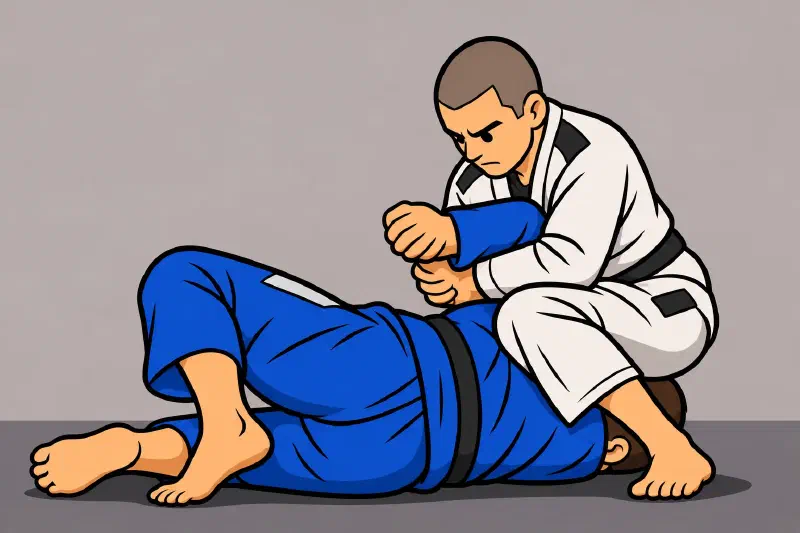
Submissions. Once you control someone, you attack. Chokes such as the rear naked choke and the triangle choke cut blood flow to the brain. Joint locks such as the kimura and the straight ankle lock push a joint toward the end of its range. The person caught taps with a hand, a foot or their voice, and the partner lets go at once.
One position needs its own mention: the guard. In BJJ, being on your back is not losing as long as your legs are between you and your opponent. From closed guard, half guard or open guard you can sweep (reverse the position) or submit the person on top. The top player’s job is guard passing: getting around the legs to a pin.
Why the tap matters
The tap is the safety system that lets BJJ be trained hard. Because a submission stops the moment someone taps, two people can spar with real resistance several times a week without the damage that comes with full-contact striking. You find out what works against a person who does not want it to work, and you get that feedback hundreds of times a year.
It also keeps people honest. You cannot talk your way through a round. That steady, low-stakes testing is why BJJ skills tend to hold up under pressure. Our guide on how to spar covers how to do it in a way that keeps you and your partners healthy.
What a class looks like
Most classes run 60 to 90 minutes and follow a similar shape:
- A warm-up, often built from BJJ movements such as bridging, hip escapes and the technical stand-up.
- Technique: the coach shows one to three related moves, and you drill them with a partner who offers little or no resistance.
- Positional sparring: you start in a set position, such as mount, with a simple goal for each person, and reset when someone achieves it.
- Rolling: free sparring in rounds of about five or six minutes, changing partners between rounds.
Beginners are often kept out of free rolling for the first few sessions, which is sensible. For the details of what to wear and what to say, see your first BJJ class.
What a match looks like
A sport match starts standing. One person scores a takedown, such as a double leg, or one pulls guard and the fight goes to the mat. It ends when someone taps. If nobody does, the result is decided by points or by a referee.
Under the most common rule set (IBJJF), points reward climbing the ladder: 2 for a takedown, sweep or knee on belly, 3 for passing the guard, 4 for mount or back control. Adult matches last five to ten minutes depending on belt. Other formats, such as ADCC and submission-only events, score differently or not at all. The full picture is in BJJ points and rules explained.
Gi and no-gi
BJJ is trained in two outfits. In the gi you wear a heavy cotton jacket, trousers and a belt, and you can grip the cloth. That slows things down and opens up collar chokes and sleeve-based guards. In no-gi you wear a rashguard and shorts, there is nothing to hold except the body, and the pace is faster and more wrestling-like. Most gyms teach both and most skills transfer. Gi vs no-gi compares them in detail.
How BJJ differs from judo, wrestling and MMA
Judo is BJJ’s parent art, and the two share many techniques. Modern sport judo rewards the throw above all: a clean throw wins the match outright, and time on the ground is short before the referee stands the players up. BJJ reverses the emphasis. Takedowns score only a little, and the ground fight can go on for the whole match. Judo throws such as osoto gari work well in BJJ.
Wrestling (freestyle, folkstyle and Greco-Roman) has no submissions. You win by takedowns, exposure and pinning the shoulders, so wrestlers never want to be on their back. In BJJ the back is a place you can fight from. Wrestling gives BJJ its best takedowns and scrambling, and wrestlers who learn submissions usually progress quickly.
MMA combines striking with grappling. BJJ is one of its core ingredients, but strikes change the choices: positions that are comfortable in sport BJJ can be costly when someone can punch you. BJJ on its own is a narrower, safer sport for a hobbyist. If self-protection is your main goal, read is BJJ good for self-defense?.
The story of how these arts split apart is in our short history of BJJ.
Who it suits
BJJ suits people who like solving problems under pressure. It is often compared to chess because each position offers a set of moves and counters, and experience beats aggression over time.
It works for a wide range of bodies. Smaller people lean on frames, guard and back attacks, while heavier people often prefer pressure from the top. Our guides for smaller grapplers and bigger grapplers go into this.
You are also not too old. Plenty of people start in their forties and fifties and train for decades by choosing positions that are kind to the body and tapping early. BJJ after 40 is written for exactly that reader.
What it asks of you is patience. Rank comes slowly, as the belt system guide explains, and the first months involve a lot of being held down. If you can accept that, the next step is simple: read the white belt survival guide, find a gym with a free trial, and go to one class.
What to remember
- BJJ is grappling: no punches or kicks, and a match ends when someone taps to a choke or joint lock or the clock runs out.
- The core idea is position before submission. You climb a ladder of positions and only then attack.
- Because you can tap at any time, you can spar at close to full effort and still go to work the next day.
- It is trained in the gi (jacket and belt) and no-gi (rashguard and shorts). Most skills carry over between the two.
- Adults of almost any age and build can start. Progress comes from steady attendance, not talent.
Questions people ask
Is BJJ the same as Japanese jiu-jitsu?
No. They share a root, but Brazilian Jiu-Jitsu grew out of judo as it was taught in Brazil in the early 1900s and specialised in ground fighting with live sparring. Traditional Japanese jujutsu schools usually cover strikes, throws and standing locks, often with less free sparring.
Do I need to be fit or strong to start BJJ?
No. Class itself builds the fitness you need, and good gyms let beginners work at their own pace. Being strong helps, as it does in every sport, but the techniques are built to work without relying on it.
Is BJJ dangerous?
It is a contact sport, so strains and bruises happen and serious injuries are possible. The risk drops a great deal when you tap early, pick careful partners and avoid ego in sparring. There are no strikes, which removes the head impacts common in striking arts.
How long does it take to get good at BJJ?
Most people feel lost for the first few months, start to hold their own against other beginners within a year, and reach blue belt in roughly one to three years of regular training. It is a long game, which is part of the appeal.
More on start here
- Your first BJJ class: what to expectWhat to wear and bring to a first BJJ class, how the session runs, how tapping works, how sore you will be and how to choose a gym.
- White belt survival guide: what to learn firstA priority order for your first 6 to 12 months of BJJ: survive, escape, hold position, then attack, with links to each skill.
- Mat etiquette and hygieneThe unwritten rules of the BJJ mat, plus practical hygiene: nails, kit washing, ringworm, staph, when to stay home and cauliflower ear.