Is BJJ good for self-defense?
Yes, with limits. BJJ is very good at controlling one unarmed person in the clinch and on the ground, and at escaping when you are pinned, and you practise it against real resistance. It does not cover striking, weapons or multiple attackers, and sport habits such as pulling guard can work against you. Awareness and avoidance come first.
The honest answer
BJJ is good for self-defense, within clear limits. It gives you tested skill at controlling one unarmed person at close range and on the ground, and at getting out from underneath someone who is holding you down. Because you spar against people who are really trying to stop you, what you learn has been tried under pressure.
It does not prepare you for everything. A typical class does not include punches, weapons or more than one attacker, and some habits that win matches would be poor choices outside the gym. So the fair summary is this: BJJ is one of the most useful things you can train for self-defense, it is not complete alone, and avoiding trouble will always matter more than anything you can do once it starts.
This guide is general information. Laws on the use of force differ from place to place, so learn what applies where you live.
What BJJ does well
You practise against resistance
Every sparring round is a small test against a person who is not cooperating. That builds timing and an accurate sense of what you can and cannot do. It also strips away false confidence. People who train regularly usually know exactly how hard it is to control a bigger, stronger person, and that knowledge alone leads to better decisions.
Clinch and takedowns
Many physical confrontations end up at grabbing range. BJJ, especially with some wrestling and judo mixed in, teaches you to manage that range: underhooks and overhooks, base and posture, and takedowns you can control such as the body lock takedown. Being tied up close also limits how hard someone can hit you. Managing distance and the clinch explains the idea: be either too far away to be hit or too close for the punch to land with power.
Control without injury
A pin lets you hold someone without hurting them. Holding mount, side control or back control until help arrives or the person calms down is often the best outcome available, and it is one that few other approaches offer. The positional hierarchy tells you which positions are safe and which are not.
Escaping from underneath
If you are knocked down or tackled, this is what you need most. The bridge and roll and elbow-knee escape from mount, side control escapes, the scarf hold escape against a headlock on the ground, and the technical stand-up to get back to your feet are among the most valuable self-defense skills in the art.
Staying calm
Being squashed, tired and uncomfortable several times a week teaches you to keep breathing and thinking in that state. That carries over.
Where the gaps are
Strikes
Sport BJJ has no striking, so many positions that are fine on the mat are risky when someone can punch. An open guard at arm’s length, or lying under half guard without controlling the head, leaves your face exposed. The fix is to control posture and distance: see guard against strikes, breaking posture in closed guard and haymaker defense to takedown.
Weapons
Grappling with someone who may have a knife or other weapon is extremely dangerous, and being tied up on the ground makes a hidden weapon harder to see and stop. BJJ does not solve this. If a weapon is involved or possible, getting away is the priority.
More than one person
On the ground with one attacker you cannot deal with a second. This is the strongest argument for staying on your feet, staying mobile and using ground skills mainly to get up again.
Surfaces and surroundings
Mats are soft and open. Concrete, kerbs, furniture and stairs are not. Being thrown or dropping to your knees hurts far more outside, which is one reason breakfalls are worth learning well. It also means you have a duty of care in the other direction: throwing or dropping someone on a hard surface can cause serious injury.
Size still matters
Technique narrows the gap between a smaller and a larger person, and it does not remove it. BJJ for smaller grapplers covers how to train with that in mind.
Sport habits to adjust
A few things that are normal in competition need rethinking.
- Pulling guard. Pulling guard is a sound sport tactic. Outside the gym, choosing to sit down in front of a standing person is a poor idea.
- Being content on your back. Guard is a strong position in a match. With strikes involved, use it to sweep or stand up, not to settle in.
- Complicated guards and leg entanglements. Inverting, lapel guards and long leg lock exchanges tie you to the ground and to one person.
- Turtle. Stalling in turtle is safe under sport rules and unsafe when someone can hit the back of your head.
- Playing for points and time. There is no referee, no reset and no rounds.
- Gym etiquette. Training partners release when you tap. Do not assume anyone else will.
None of this means sport training is wasted. The core skills of balance, pressure, escapes and control are the same. It means you should know which parts of your game depend on the rules.
What transfers best
If self-defense is one of your reasons for training, give extra attention to these.
- Staying on your feet: stance and movement, the sprawl and single leg defense.
- Getting up: the technical stand-up, practised until it is automatic.
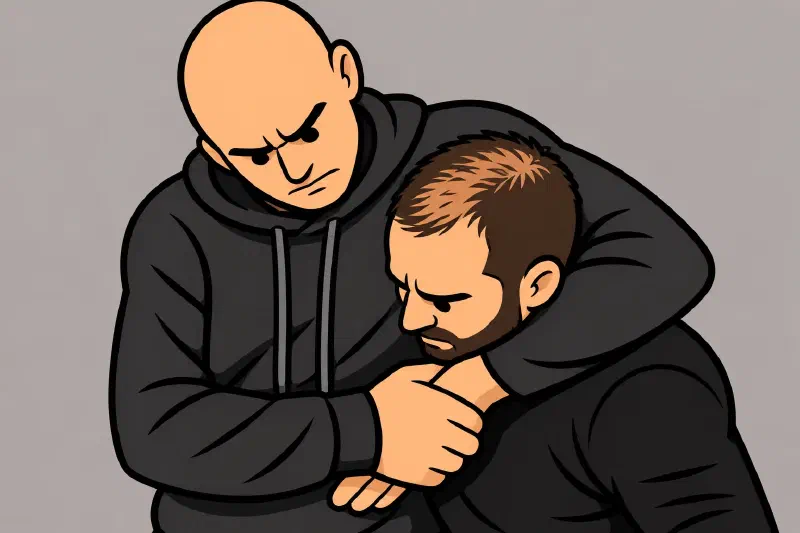
- Common grabs: standing headlock defense, standing guillotine defense and bear hug and grab defense.
- Top control: mount, knee on belly, which lets you see around you and stand up quickly, and back control.
- A small number of dependable finishes, led by the rear naked choke, which controls a person without relying on pain. Any choke must be released as soon as the person stops resisting.
- Closed guard with posture control, a sweep such as the hip bump, and standing up.
The priority order is worth stating: avoid, leave, stay standing, get on top, get up, and only then think about submissions.
What to add
- Some striking awareness. You do not need to become a boxer. A few months of boxing, kickboxing or MMA classes teaches you what punches look like, how to cover up and how to close distance safely. Some BJJ gyms run self-defense or MMA-style classes that include this.
- More stand-up. Ask to start rounds standing. Many hobbyists begin every roll on their knees and never practise the phase that matters most. Judo and wrestling for BJJ are both excellent.
- Scenario practice. Now and then, with a trusted partner and light contact, practise from a headlock, against a wall, or with the goal of standing up and creating distance instead of submitting.
- The non-physical skills. Notice what is around you, keep your distance from people who are agitated, speak calmly, give up property without a fight and leave early. These prevent most situations from becoming physical at all.
- Local law. Know the basics of what counts as reasonable force where you live.
The bottom line
Train BJJ for self-defense and you will gain real, pressure-tested ability in the range where many assaults end up, along with fitness and composure. Stay honest about what it does not teach, fill those gaps over time, and keep avoidance as your first skill.
If you are new, start with what is Brazilian Jiu-Jitsu? and your first BJJ class. For how the art’s self-defense roots and sport side developed, see a short history of Brazilian Jiu-Jitsu, and for the ideas behind it, the founding principles of jiu-jitsu. Gi vs no-gi compares the two ways to train.
What to remember
- BJJ’s strengths are the clinch, control on the ground, escapes and the ability to stay calm under pressure.
- Its gaps are striking, weapons, more than one attacker and hard surfaces.
- Sport habits such as pulling guard, playing off your back and ignoring strikes need adjusting.
- For self-defense, prioritise getting up, staying on top and leaving over winning by submission.
- Avoidance, awareness and de-escalation prevent far more harm than any technique.
Questions people ask
Is BJJ enough for self-defense on its own?
It covers an important part very well, but not all of it. You would also want basic skill at managing distance and strikes, some takedown ability and, above all, good habits of awareness and avoidance. BJJ combined with those is a strong base.
How long do you need to train BJJ before it is useful for self-defense?
There is no fixed point. Most people notice within several months of regular training that they can hold their own against untrained people of similar size on the ground. Reliable skill under stress takes longer, and size and strength differences still matter.
Is gi or no-gi better for self-defense?
Both transfer. The gi teaches you to use and deal with clothing grips, which matters when people wear jackets. No-gi is closer to dealing with someone in a T-shirt and puts more weight on wrestling and clinch control. Training some of each is ideal.
Should I go to the ground in a real fight?
Not by choice. Staying on your feet lets you leave. Ground skill matters because you may be taken down or fall, and then you need to be able to protect yourself and get back up. If you do end up on the ground, being on top is far safer than being underneath.
More on principles
- The founding principles of jiu-jitsuTen principles behind every BJJ technique, from leverage and position before submission to frames and efficiency, each with a mat example.
- How to build your BJJ game planHow to build a BJJ game: one or two connected options per position, chosen to fit your body type, age, flexibility and gi or no-gi training.
- A short history of Brazilian Jiu-JitsuHow BJJ grew from Kodokan judo and Mitsuyo Maeda through the Gracie and Fadda lineages, vale tudo and UFC 1 to modern sport BJJ and no-gi.