Gi vs no-gi: the real differences and which to start with
Gi and no-gi are the same art with different handles. The gi adds cloth grips and friction, which slows the pace and rewards patience. No-gi is slipperier and faster and leans on wrestling and leg locks. Start with whichever your gym teaches best and you will attend most. If you can do both, do both.
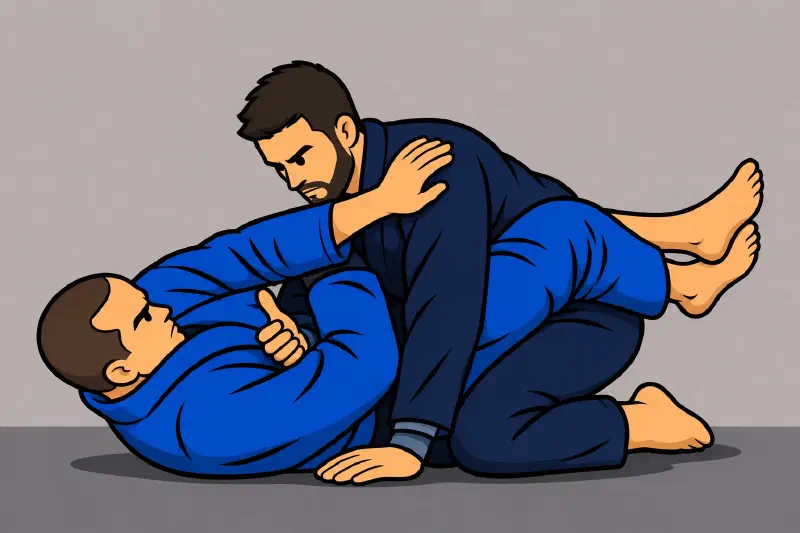
Gi and no-gi are two versions of the same art. In the gi you wear a heavy cotton jacket, trousers and a belt, and you can grip all of it. In no-gi you wear a rashguard and shorts, and you can only grip the body. Everything else follows from that. If you are choosing where to start, pick the one your gym teaches well and that fits your schedule. Both teach the same positional hierarchy, and skills move between them more than people expect.
Grips change everything
In the gi, the collar, sleeves, lapels and trousers are handles. A good sleeve grip can hold an arm in place for a long time, and learning to make and break those grips is its own skill, covered in gi grips and grip fighting. Grips let a smaller or slower person stop movement before it starts.
Without the jacket you control the body directly: wrists, elbows, the back of the neck, underhooks and overhooks. These grips are weaker and shorter lived, so you have to keep re-gripping. That contest is no-gi hand fighting, and it rests on underhooks, overhooks and pummeling. The Russian tie is a typical no-gi answer to the missing sleeve.
Pace and friction
Cloth creates friction. A sweaty gi sticks to a sweaty gi, and grips anchor people in place. Gi rounds tend to be slower and more deliberate, with long grip battles and gradual improvements in position. Escapes are harder, because your opponent can hold your trousers or collar while you try to move.
No-gi is slippery. Limbs pull free, pins are harder to hold, and scrambles happen more often. Skills such as wrestling up, the front headlock and rides and mat returns matter more. The pace is higher, though a good no-gi player still slows things down with body-to-body pressure, as in the body lock pass.
If you are older or carrying a few injuries, neither is automatically kinder. The gi is slower but hard on fingers. No-gi is easier on hands but has more scrambling. BJJ after 40 goes into how to manage both.
What only exists in the gi
Some guards depend on cloth. Spider guard, lasso guard, collar sleeve guard and the lapel guards have no direct no-gi version. Some takedowns do too, such as the collar drag and the classic sleeve and lapel versions of seoi nage.
Then there are the collar chokes: the cross collar choke, bow and arrow choke, sliding collar choke, loop choke, baseball bat choke and the wider family of lapel chokes. In the gi, your opponent’s jacket is a weapon against them from almost anywhere.
What is mostly a no-gi game
Nothing in no-gi is physically impossible in the gi, but some things are far more common without it. Front headlock attacks such as the guillotine, D’arce choke and anaconda choke are easier to slide in on bare skin. Wrestling-style takedowns such as the double leg and single leg face fewer grips. Guards built on overhooks and leg control, such as rubber guard and butterfly guard, carry a lot of the load.
The largest difference is the lower body, which comes down to rules.
Rules and leg locks
Under IBJJF rules, heel hooks and knee reaping are legal only for adult brown and black belts in no-gi. They are illegal in the gi at every belt and illegal in Masters divisions. The straight ankle lock is legal for adults at every belt in both. ADCC and most submission-only events allow heel hooks for adults, so check your event’s rules.
The result is that no-gi culture trains leg entanglements such as the saddle and the inside heel hook much more, and many gi-focused gyms barely touch them. If your gym does no-gi, you will want leg lock fundamentals and heel hook defense fairly early. The full picture is in which leg locks are legal at each belt, and scoring is covered in BJJ points and rules explained.
What stays the same
Most of what you learn in the first two years is identical. The hip escape, frames, base and posture and guard retention do not care what you are wearing. Neither do mount, side control or back control.
The core submissions cross over as well: the rear naked choke, triangle choke, armbar, kimura and arm triangle choke. So do half guard, closed guard and passes such as the knee cut. If you build your game on these, switching is a matter of changing grips, not relearning jiu-jitsu.
How each helps the other
Gi training punishes sloppy defence. When someone can hold your sleeve, you cannot rip an arm out of an armbar or slide out of mount on sweat. You learn to escape with position and timing. You also learn patience and how to work through a strong grip.
No-gi training punishes dependence on handles. You learn to control with your chest, hips and head position, to move your feet when passing, and to react in scrambles. People who only train gi often feel lost for a few weeks when the grips vanish. People who only train no-gi often feel stuck when someone finally holds their collar and sleeve. A few months of the other one fixes both.
Which should you start with?
An honest recommendation by goal:
- You want a hobby for the long run. Start with whatever your gym’s fundamentals class uses. Coaching quality and class times matter more than uniform.
- You want to compete under IBJJF or work through the belts. Train mostly gi, with some no-gi. Belt promotion in most academies is tied to gi class. See the BJJ belt system.
- You want MMA, or you come from wrestling. Start no-gi. It is closer to what you know and what you will use.
- Self-defense is your main reason. Do both. People wear jackets in real life, and they also wear t-shirts. Read is BJJ good for self-defense?.
- Your hands or fingers are already sore. Lean toward no-gi, and tape your fingers on gi days. See common BJJ injuries and how to avoid them.
If your gym offers both and you can train three times a week, a simple split is two sessions of your main format and one of the other. For kit, see the BJJ gear guide. When you start building a personal game across both, how to build your BJJ game plan will help you choose positions that work with and without the jacket.
What to remember
- The positions, escapes and most submissions are the same. The grips, pace and rules change.
- The gi adds collar chokes and sleeve and lapel guards. No-gi adds heel hooks, wrestling ties and faster scrambles.
- Gi habits teach patience and defence. No-gi habits teach movement and body-on-body control.
- Pick by goal and by what your gym runs well, then cross-train once the basics feel familiar.
Questions people ask
Is gi or no-gi better for beginners?
Either works. The gi slows things down, so you get more time to think and escapes have to be technically clean. No-gi is simpler to dress for and has fewer grips to learn. The best choice is the class you will attend consistently with a coach who teaches fundamentals.
Does gi training help no-gi?
Yes. The gi makes escaping harder because your opponent can hold you with cloth, so it builds precise defence and patience. It does not teach no-gi hand fighting or leg lock defence, so you still need mat time without the jacket.
Is no-gi better for self-defense or MMA?
No-gi is closer to MMA because nobody wears a jacket in the cage. For self-defense the answer is less clear, since people on the street usually wear clothes you can grip. Training both covers more situations.
Are leg locks only a no-gi thing?
No. Straight ankle locks are legal in the gi at every adult belt, and kneebars and toe holds open up at brown belt under IBJJF rules. Heel hooks and knee reaping are the part that is limited to no-gi, and only for adult brown and black belts under IBJJF.