Learn jiu-jitsu
that fits your body.
195 techniques for gi and no-gi, each written out step by step with the best free videos beside it. Filter the whole library by your age, flexibility and athleticism, and keep track of what you have learned.
- 195 techniques
- 1164 checked videos
- 27 guides
- 0 sign-ups or paywalls
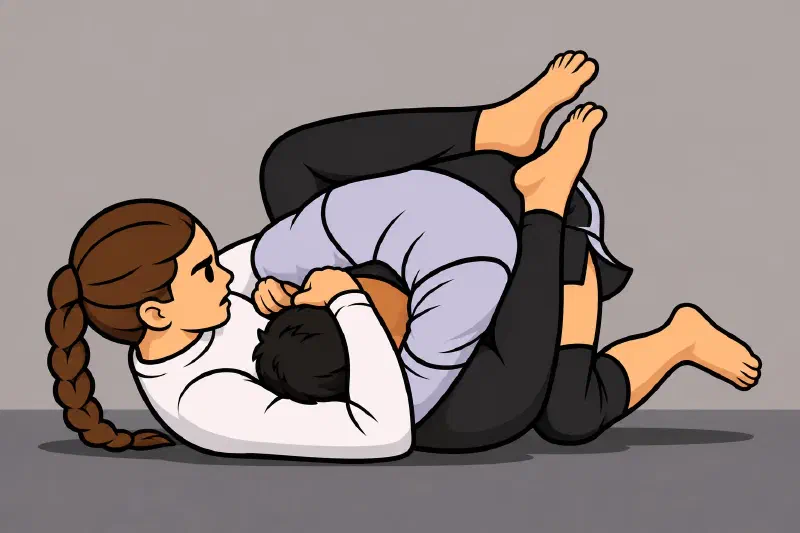
Welcome back
The whole fight, start to finish
Jiu-jitsu is a chain of positions. Pick the link you want to work on.
On the feet
Get it to the ground on your terms.
In the guard
Control, sweep and attack from your back.
On top
Pass the legs, pin, and take the back.
The finish
Strangles and joint locks.
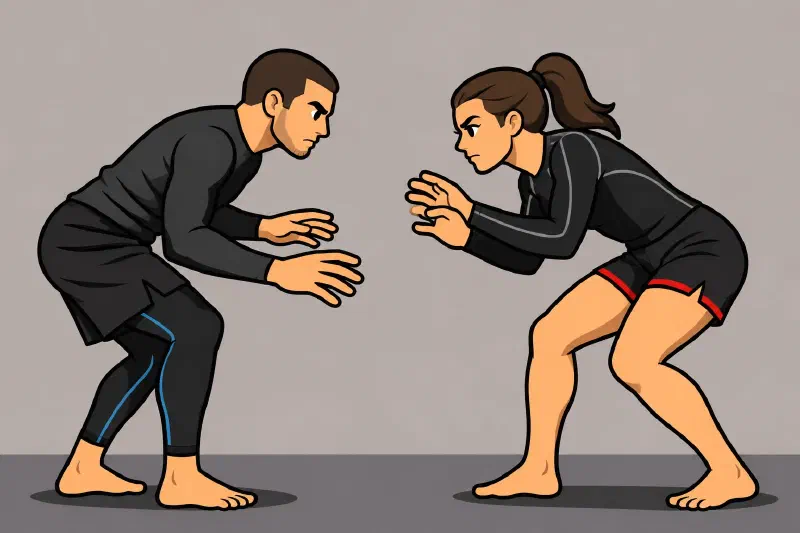
Not every move is for every body
A berimbolo asks for hips a 50-year-old desk worker may not have. A knee cut pass does not. Every technique here is rated for the flexibility and athleticism it demands, how it treats an over-40 body, and which joints it loads.
Answer five questions and the library sorts itself around you. Your answers stay in this browser.
Set up my profile- Knee cut passThe knee cut slides your knee across their thigh to the mat while an underhook and head control keep them flat. pass GiNo-gi Flex Athletic
- Toreando passThe toreando, or bullfighter pass, controls both legs, moves them aside and steps around to side control or knee on belly. pass GiNo-gi Flex Athletic
- Triangle chokeThe triangle choke traps the head and one arm between your legs and strangles from guard. Learn the angle, the lock and how to finish without hurting your knee. choke GiNo-gi Flex Athletic
- De La Riva guardAn open guard against a standing opponent where your leg wraps around the outside of their lead leg to off-balance, sweep and take the back. guard GiNo-gi Flex Athletic
- Rubber guardEddie Bravo's no-gi closed guard system that uses a high leg held across the opponent's back to lock their posture down. guard No-gi Flex Athletic
- BerimboloAn inverting spin from De La Riva guard that takes you underneath and behind the opponent to reach their back or come up on top. back take GiNo-gi Flex Athletic
Follow a path
Ordered study plans, so you always know what to learn next.
- First 90 days What to learn first as a new white belt: move, survive, escape, then hold and attack from the positions you will see every class. 26 techniques, gi or no-gi
- Gi fundamentals The core of a gi game: grips, collar chokes, the classic guards and the passes that beat them. 22 techniques, gi
- No-gi fundamentals The core of a no-gi game: hand fighting, wrestling up, body lock passing, front headlock and safe leg locks. 28 techniques, no-gi
- The over-40 game A complete game built on pressure, frames and chokes, chosen to be kind to knees, necks and lower backs. 29 techniques, gi or no-gi
- Pressure top game For bigger, stronger or slower grapplers: take the top, pass with weight, and make every pin heavy. 22 techniques, gi or no-gi
- The smaller grappler's game For lighter people who roll with heavier partners: keep distance, refuse the pin, take the back. 22 techniques, gi or no-gi
- Leg locks from zero Positions before submissions: learn to control, defend and finish leg locks in a safe order. 18 techniques, mostly no-gi
- Blue belt toolkit After the basics: one or two reliable options in every position, connected into chains. 29 techniques, gi or no-gi
Practice between classes
Tools that train your decisions, not just your memory.
- Position flashcardsYou are in their closed guard. What do you do? Flashcards for every major BJJ position, top and bottom, with spaced repetition and the techniques that fit your body.
- My game treeChoose your plan A and plan B in every position to build your own jiu-jitsu game, print it on one page, and quiz yourself on it until it is automatic.
- Reaction drillsYour opponent reacts. What do you do? Multiple-choice BJJ scenarios that teach you to chain techniques together, with an explanation for every answer.
- Chain mapSee how every jiu-jitsu technique connects to the next, explore chains from takedown to submission, and solve chain puzzles in as few moves as possible.
Guides
The things a good coach tells you between rounds.
- Start hereWhat is Brazilian Jiu-Jitsu?A plain explanation of Brazilian Jiu-Jitsu: how it works, what a class and a match look like, and how it differs from judo, wrestling and MMA.
- Start hereWhite belt survival guide: what to learn firstA priority order for your first 6 to 12 months of BJJ: survive, escape, hold position, then attack, with links to each skill.
- PrinciplesThe founding principles of jiu-jitsuTen principles behind every BJJ technique, from leverage and position before submission to frames and efficiency, each with a mat example.
- PrinciplesHow to build your BJJ game planHow to build a BJJ game: one or two connected options per position, chosen to fit your body type, age, flexibility and gi or no-gi training.
- PrinciplesThe BJJ belt system: what each belt means and how long it takesBJJ belts from white to black: what each one means, stripes, IBJJF minimum times, realistic timelines and what to focus on at every rank.
- Training smartBJJ after 40: how to start, train and lastHow to start and keep training jiu-jitsu after 40: recovery, partners, tapping early, and the guards, passes and submissions that suit an older body.
- Training smartJiu-jitsu when you are not flexibleStiff hips and tight hamstrings do not stop you learning BJJ. The positions that work, what to leave for later and how flexibility improves.
- Gi and no-giGi vs no-gi: the real differences and which to start withHow gi and no-gi jiu-jitsu differ in grips, pace, rules and leg locks, what exists in only one, and which to start with for your goal.
- CompetitionWhich leg locks are legal at each belt?IBJJF leg lock rules by belt for gi and no-gi, what knee reaping means, how ADCC and submission-only differ, and how to train leg locks safely.
Common questions
Can you learn BJJ from free videos?
You can learn what techniques are, why they work and what to practise, and that makes your mat time far more productive. You cannot learn timing or pressure without a partner. Use this site to choose one position, study it, then drill it and try it in sparring at a gym with a qualified coach.
Should I start with gi or no-gi?
Start with whichever your gym teaches most often and you enjoy most. The gi slows the game down and teaches grips and patience. No-gi is faster and rewards wrestling and body positioning. Most of the fundamentals carry over. Use the Gi, Both and No-gi switch at the top of any page to see only what applies to you.
What should a BJJ beginner learn first?
Learn to stay safe and get out of bad positions before you learn to attack. That means the hip escape, bridging, frames, the two mount escapes, a side control escape, closed guard basics and one or two simple submissions. The First 90 days path puts these in order.
Is BJJ realistic to start after 40?
Yes. Many people start in their forties and fifties and train for decades. Choose techniques that rely on position and pressure rather than speed and flexibility, pick your training partners, tap early and manage recovery. Every technique here carries an over-40 rating and notes on adapting it.
How are the flexibility and athleticism ratings decided?
Each technique is rated for what it demands of your body, from 1 (low) to 3 (high). Flexibility covers hip mobility, inversion and deep knee bend. Athleticism covers speed, explosiveness and scrambling. The ratings follow mainstream coaching advice and are a guide, not a rule. Your coach knows your body better.
Do I need an account?
No. There is no sign-up and nothing to pay for. Your profile, saved techniques and progress are stored in your own browser, and you can download a backup from the My game page.